
Sometimes getting a comfortable, effective latch has less to do with what you're doing with your breast and more to do with how your baby is positioned.
If you've ever found yourself leaning forward, holding your baby's head in place, or trying to maneuver a tiny mouth onto your nipple, you're not alone. Many parents are surprised to learn that a small adjustment in positioning can make a big difference.
One position we love teaching families at GROW is called Biological Nurturing, sometimes referred to as laid-back breastfeeding. Instead of sitting upright and bringing your baby to the breast, you recline comfortably and allow your baby to rest against your body.
This position uses gravity, your baby's natural feeding reflexes, and close body contact to help create the conditions for a more comfortable latch.
Let's talk about how to get started.
What is Biological Nurturing?
Biological Nurturing is a breastfeeding position that allows your baby to lie against your reclined body, with their tummy facing yours and their head near your breast.
Rather than holding your baby in a rigid position or directing their head toward the nipple, you provide a secure place for them to rest, move, and explore. Your baby can use their natural feeding reflexes to seek out the breast and work toward latching.
The goal isn't to leave your baby to figure everything out on their own. It's to create a supportive position where their body can do some of the work, while you provide the stability and guidance they need.
How to position your baby
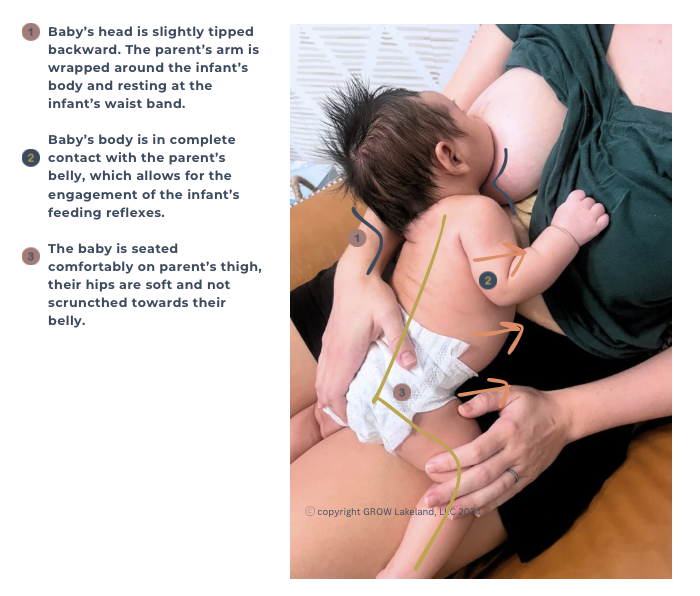
A good starting point is to think about four points of contact between your baby and your body: their mouth, chest, hips, and thighs.
These points of contact help your baby feel secure and supported while allowing their body to remain in a comfortable feeding position.
1. Start by reclining comfortably
Find a comfortable place to sit and lean back. You don't need to be completely flat. A supported, semi-reclined position is usually a good place to start.
Use pillows behind your back or under your arms as needed. Your shoulders should be relaxed, and you should not feel like you're leaning forward to reach your baby.
Remember: bring your baby to your breast, not your breast down to your baby.
2. Bring your baby's body against yours
Place your baby tummy-down against your body, with their chest and belly resting against you.
This close contact helps your baby feel secure and supports the engagement of their natural feeding reflexes.
Ideally, your baby's mouth, chest, hips, and thighs will all have contact with your body. You want your baby to feel supported from head to bottom rather than balancing or twisting to reach the breast.
3. Allow your baby's head to tip slightly backward
This is one of the most important details.
Your baby's head should be slightly tipped back rather than tucked forward with their chin pressed toward their chest. Think about the position your own head would need to be in if you were going to take a big drink from a cup.
A little room for head extension helps your baby open their mouth and approach the breast with their chin leading.
Avoid pushing the back of your baby's head toward the breast. Instead, support their body and allow their head the freedom to move.
4. Support your baby's body with your arm
Your arm can wrap around your baby's body, resting along their back or near their waist.
This provides gentle stability without restricting their movement. Your baby should feel secure against you, but their head and neck should still have room to move.
You aren't trying to hold your baby in a fixed position. You're helping them stay close while allowing them to participate in finding the breast.
5. Keep your baby's hips soft and relaxed
Your baby should be comfortably supported across your body or thigh, with their hips relaxed rather than tightly tucked or scrunched toward their belly.
Pay attention to the way their body is resting. If their hips are curled tightly underneath them or their body is twisted, make a small adjustment until they can relax against you.
A comfortable lower body makes it easier for your baby to maintain contact with your body and coordinate their movements during feeding.
Let your baby come to the breast
Once your baby is comfortably positioned, bring their nose near your nipple and give them an opportunity to explore.
You may notice rooting, head movements, a wide-open mouth, or little movements as they search for the breast. These are all part of the process.
When your baby opens wide, their chin should make contact with the breast first, with the nipple directed toward the roof of their mouth.
You can offer gentle support or help guide your baby as needed. Biological Nurturing isn't about avoiding hands-on assistance. It's about using a position that supports your baby's natural movements instead of working against them.
What if it doesn't work right away?
Like any breastfeeding position, Biological Nurturing may take a little practice. Some babies settle into it easily, while others need more support or a different position altogether.
If you're having trouble, check a few things:
Are you comfortable? If your shoulders are tense or you're leaning forward, adjust your own position first.
Is your baby close enough? Your baby's body should be resting against yours, not reaching toward the breast.
Is their head tucked forward? Make sure there's room for their head to tip slightly backward.
Are their hips relaxed? Avoid positioning your baby with their legs tightly curled underneath them.
Is your baby ready to feed? Watch for early hunger cues rather than waiting until they're very upset. A frustrated baby may have a harder time organizing their movements and latching.
If your baby is struggling to latch, repeatedly slipping off, or having difficulty maintaining a deep latch, there may be more going on than positioning alone. Oral motor function, muscle tension, body positioning, and milk flow can all influence how a baby feeds.
Does Biological Nurturing work for everyone?
No single breastfeeding position works for every parent and baby.
Biological Nurturing can be especially helpful for families who find traditional upright positions uncomfortable or who want to encourage their baby's natural feeding reflexes. It may also be worth exploring if your baby tends to push away from the breast, struggle with positioning, or become frustrated when their head is held in place.
That said, some babies and parents benefit from other positions, including cross-cradle, football hold, or side-lying. The best position is one that allows your baby to feed effectively and comfortably while keeping you comfortable, too.
If you're experiencing persistent pain, difficulty latching, or concerns about milk transfer, an individualized feeding assessment can help identify what's getting in the way.
A good latch starts before your baby reaches the breast.
At GROW Lactation Services, we look at the whole feeding picture. That includes positioning, oral motor function, muscle tone, maternal comfort, and how your baby transfers milk.
Sometimes a small adjustment is all it takes. Other times, positioning is just one piece of a larger puzzle.
Our goal is to help you understand what's happening during a feed and give you practical tools that work for your baby and your body.
If you're having trouble finding a comfortable latch, we'd love to help. You don't have to spend every feeding session trying to figure it out on your own.
